

Tuesday, November 1, 2011


blogggg
Train-the-Trainer is in my life for good, I think.
After just completing a series at work in the US, I was looking forward to
seeing what this one would be like here. From last week, teaching and
collaborating with health workers of various levels to do VIA, biopsy,
cryo, and LEEP every day, it was a nice contrast to focus on
Train-the-Trainer. Each first day starts out chaotic, as Carol has said in
setting that tone in he usual infectiously calm way, but it's always fine.
Yesterday, we started with a new trainee in VIA, an experienced examiner,
and a trainer. I started with a group of una medica, who was the trainer,
y dos enfermeras. who were learning VIA. My part was to answer questions
and support the trainer. Pretty quickly, we started talking about "tough"
cases, incorporating biopsies with treatment and the role of a Pap here.
More to come there...
El Salvador is so beautiful! -Michele Bunker-Alberts
Tonight after clinic, we said goodbye to another one of our group. It's only been a little over a week, but, after a few days of this, the group actually becomes pretty familiar and ours works really well together. I'm going to miss Eve. We taught her final session this trip together this afternoon, but it has been really fun to have been here with her, learn from her, and get lost walking in Leon with her and Jaynia. Next trip, when she brings her daughter too, my daughters can show her daughter "the ropes" of PINCC support...
Today we had another busy city clinic. Things are very well-organized in El Salvador in terms of our group sessions and the support it requires for municipal clinics without many resources to encourage their doctors and nurses to both learn and practice IVAA. Further, our participants are all enthusiastic about womens' health and providing appropriate care. Our groups today did many exams - about 75 patients and several cryotherapies and LEEPs. During the patient sessions, the examiners educated women about HPV and cervical cancer, the importance of screening, and more generally about their health, contraception, breast care, negotiating safer sex with partners, about reducing sexual violence and how to connect to support around all of those issues. El Salvador's epidemiologic data, including cases of Dengue by neighborhood - which there's been an increase in this year with the rains, immunizations, even morbidity reports are posted throughout its clinics and in every exam room are posters about breastfeeding, nutrition, hypertension, and the steps of prenatal care by gestational age.
Okay, so back to us.
Today we did more Train-the-Trainer and each of us worked as "group advisors" and were there to both offer additional learning and to support the trainers as they taught IVAA. The group I worked with asked lots of questions about Pap diagnoses, cytobrushes, biopsies, and distinguishing lesions - all very rich discussions with a lot of detail.
Tomorrow is Dia de los Muertos. We're heading out to a few cemetaries and then to the beach for a few hours. Again, El Salvador is an amazing country and it's nice to be doing work that people are really excited to be learning. More to come, keep reading. -Michele Bunker-Alberts
day one El Salvador
we were off to a flyimg start in El Salvador with another stellar
PINCC group - all extremely hard-working and always maintaininh a
sense of humor. We spent our first day at a clinic in San Martin that
previous vounteers will remember as very busy with a BIG patient
volume. Alongside the Trainers and Trainees - the site is a new
´TrainñtheñTrainer´site, we saw 80-90 patients, 4 cryos and a LEEP.
-Lyell Fox, photos to follow
PINCC group - all extremely hard-working and always maintaininh a
sense of humor. We spent our first day at a clinic in San Martin that
previous vounteers will remember as very busy with a BIG patient
volume. Alongside the Trainers and Trainees - the site is a new
´TrainñtheñTrainer´site, we saw 80-90 patients, 4 cryos and a LEEP.
-Lyell Fox, photos to follow
Saturday, October 29, 2011
Saludos de Leon!




Monday and Tuesday we were in El Sauce at a hospital that's been up and running for 1 year. There was a full waiting room when we arrived at 7am with many women coming from far away homes to be examined. In total, we saw 50 patients over the 2 days, all very grateful for us being there.
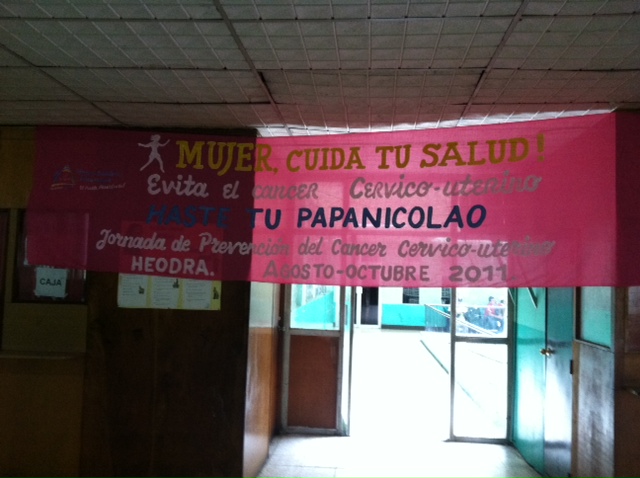
Tuesday night we headed back to Leon, and have spent the rest of the week at HEODRA, the hospital here. We had wonderful trainees and worked with wonderful people that helped coordinate the program. I got to see a few exams and procedures and it was very clear that every single one of the women that we saw were extremely grateful for us, even when there are several people crowded around and looking at their cervix. One thing we made sure to do was to get the patients who had a history of sexual abuse an opportunity to speak with a psychologist, this was very important as many of these women don't get a chance to do this and many of them have had such difficult lives. It's great to actually see all of the wonderful things PINCC is doing for these women.
It was a successful week for PINCC and an incredible experience to have.
A video of the trainees singing the Nicaraguan birthday song to me, which was so sweet
http://www.youtube.com/watch?v=-ybdn6ZHwp8
A video of Carol's longtime friend Carola singing at her restaurant La Olla Quemada where we had dinner on Friday night
http://www.youtube.com/watch?v=wz39I8T-vIQ
Jaynia Anderson
Friday, September 30, 2011

Wednesday, September 28, 2011
New York Times
On September 26, 2011 The New York Times published an article entitled “Fighting a Cancer with Vinegar and Ingenuity. The article discusses how doctors in Thailand use the same method as PINCC to save women from dying of cervical cancer and praises them for their resourcefulness and cost effective methods. To read the full article Please go to http://www.nytimes.com/2011/09/27/health/27cancer.html?_r=1
Dr. Kay Taylor sent the following letter to the editor:
"Donald McNeil’s article (Sept. 27: A little vinegar and ingenuity) on cervical cancer prevention services shed an important light on a hardly-covered issue. The cervical cancer epidemic in the southern hemisphere has been given little support or attention, despite the death rate in Africa and Latin America being almost as high as maternal mortality. Yet cervical cancer – unlike other cancers -- is completely preventable.
PINCC (Prevention International: No Cervical Cancer) is an organization that brings American volunteer doctors to train local medical personnel in Africa, India and Latin America. We then donate the needed equipment to create self-sufficient centers for diagnosis and treatment. The unsung heroes of this movement are the many doctors, mid-levels, and lay people who pay their own way and donate their time to help the poor and high-risk women ignored by many countries’ health systems. However, funding for this work is difficult to obtain, unlike maternal/ child health or HIV/AIDS.
I applaud the George W. Bush Presidential Center for its recently announced “Pink Ribbon/ Red Ribbon” program to help defeat cervical cancer in Africa and Asia. They will work with PEPFAR programs, so that cervical screening will finally be included in HIV/AIDS care. At last, public health programs are recognizing this neglected public health epidemic. We can save so many women from a terrible death, with such simple tools and the great hearts of our volunteers! "
PINCC encourages our supporters to send similar letters of their experience with PINCC to New York Times' editor at letters@nytimes.com
Monday, September 19, 2011
An African Urban Pilgrimage


Our fall East Africa Campaign is over, and all our great volunteers are off on safaris or heading home. It's been so heartwarming and thrilling to watch our 3 continuing sites grow and become independent! The biggest thrill, though, was going out to a small rural hospital on the lower slopes of Mt. Elgon, in far western Kenya, to start a training of health workers from 5 very rural sites. This group was recruited by three of our trainees in Kitale and Kapenguria, They have gone out to these sites, doing one-day screenings and bringing women with abnormal results in for treatment. The doctors, nurses, and clinical officers were very excited about the techniques, and asked to be trained. We had 12 new people begin training, and 3 observers from other programs, as well as 4 of our graduates there to help start the new ones out. They came from many miles away, traveling since dawn in small buses called matatus. All had read the material sent, and were most enthusiastic students. The word had spread among the communities as well, and every day the waiting room filled to overflowing in the morning. We could only see about half the women; but the others were booked to come back to our centers during the next weeks. We left screening kits for the 5 hospitals and dispensaries to continue screening women during the 6 months until our return, when we will see and treat any positive cases. The wonderful outreach team is organizing a non-profit to continue spreading this work over the entire area, and we are assisting them to find funding and equipment, and donating much of it ourselves. We'll be showing a map of how much of the country is now getting care at our Walkathon on Sept. 24, and will then have it on the website. Watch for more great pictures as well! Today, Monday Sept. 12, Pat Sax and I (Kay Taylor) took a walking pilgrimage towards fulfilling a dream held since 2006, when we first came to Kenya. Ever since our first visit to the Kibera slums, second largest slum in the world, we have wanted to establish a cervical cancer screening and treatment site for these women who struggle daily for the bare essentials of life. One million people live in 700 acres here, on unimproved dirt in squalid mud rooms with tin roofs. Each little cubicle holds a family of 2, 3, 4 or more, with an open window and door covered by a piece of cloth. There is no water, electricity, or sewers; the rutted paths are strewn with garbage and plastic bags used as toilets. Small fires burn between structures and along the fronts, for heat, cooking and trash destruction. In a misting rain, we carefully picked our way through the mud and rocks for about half a mile from the dirt road which ended at defunct railroad tracks, along with hundreds of other people carrying food, water, bags, pushing wheelbarrows, or just kids going to and from school in uniform. We kept our eyes mostly on the path to keep from slipping into the streaming gutters of oily filth. At last, we reached our goal: Shining Hope School and Clinic, on the far side of the slum from the road. This will be our third clinic in Kibera to attempt a permanent program. The previous ones failed to stay in business. The enthusiastic group of Kenyans and Americans who built this 2-story clinic of cement, rock and wood greeted us happily. We were shown around the facility, meeting teachers, nurses, lab workers, a clinical officer and Dr. Henry, who tend to men, women and children from this desperate camp every day. They proudly tell us of their HIV screening program and the soon-to-be-established ARV treatment program; the 400 women they have in prenatal and family planning; and the immunization program for the babies and children. It only costs 150 shillings (about $1.60) for a person to receive all health care services for a week, including lab tests, procedures and medicines. We discussed our cervical cancer screening and treatment training program with Dr. Henry and two administrators from the USA, explaining our goal of helping them to have a cervical screening and treatment program independently functioning and fully equipped within 2 years. We all knew there would be problems to overcome, but felt they could be worked through, and left with the intent to start training in February of 2012. We were waved off by some of the 64 primary schoolgirls who attend school here. As we walked back across the crowded, slippery paths, I thought about bringing our team of American doctors, nurses and other volunteers along this walk twice a day, and moving in our equipment suitcases on the carts and wheelbarrows navigating the trails around us. Would they tolerate it? It reminded me of the famous pilgrimage in Spain through the Pyrenees to the sea in Portugal: self-denial and deprivation of our comfortable, clean way of life for the week of work, if not the months that journey requires. We will need to prepare our team carefully. But when I see a mother welcome her neatly uniformed children back from school with a smile, I'm awed by the amount of planning, work and love that this daily routine requires. I think our group will thrive on the challenge, and be invigorated by the hope and healing our training will bring. These are mothers and grandmothers motivated not only to survive, but to help their children to rise to better things. Surely we can spend a few uncomfortable days to give them the chance to avoid this silent killer, and live to see the children graduate and thrive. The gratitude we receive is certainly its own reward!
Tuesday, August 30, 2011

Monday, August 29, 2011
Update from Africa
As usual, Africa is somewhat chaotic, and we struggle with spotty electricity, overworked staff, inability to hook up the cryotank, scant resources; but we have made major strides despite all this in our Gombe, Uganda clinic. The health workers are very excited and enthusiastic, both clinical and community workers. The Chief Medical Officer, Dr. Lule Haruna, has been given responsibility as District Health Officer as well, and 2 of his doctors were sent for further training, so they were really tight on doctors. But he is so committed, he found time to study the techniques in the evenings, and came for training in LEEP; he scored only one part wrong answer on our post-test, and is excellent at teaching. The community health team has started insisting the HIV+ women come for screening, and we did 5 LEEPs, saving these lives. There were 4 other LEEPs as well. I think Gombe will be a very successful program!
Subscribe to:
Posts (Atom)
